A boat battery can read full voltage and still be dead. Voltage only shows surface charge. It says nothing about the capacity behind it. A battery down to a fraction of its cold cranking amps will sit at 12.7 volts, then collapse the second you ask it to turn an engine. Only a load test shows the truth.

Who this is for
You turn the key and the engine either grinds slowly or does nothing. You put a meter on the battery and it reads fine. So you start looking elsewhere. Starter, solenoid, ignition switch, battery switch, key barrel, wiring. Every one of those is a legitimate suspect, and every one of them costs time and money to rule out.
This page is for the owner about to start down that path, and for the owner who has already spent three weeks on it. It is also for anyone who wants to understand the batteries on their boat properly, because most of the trouble comes from not knowing what the numbers on the label mean.
The situation, as owners meet it
The pattern repeats so often it is almost boring. An engine cranks slower than it used to. Nobody notices, because it still starts. Then one morning it does not. The owner checks the voltage, sees 12.6 or 12.7, and concludes the battery is good. From that moment on the battery is off the suspect list, and everything else on the boat is on it.
Meanwhile the actual problem is sitting in plain sight with a healthy number on its face. Batteries do not fail the way a light bulb fails. They fade. They lose the ability to deliver current long before they lose the ability to hold a voltage, and the meter cannot see the difference.
What a battery actually is
A lead acid battery is a box of chemistry that stores electricity and gives it back on demand. Inside are lead plates sitting in an electrolyte, which is sulphuric acid diluted with water. When you draw power, the acid reacts with the plates and pushes electrons out through the terminals. When you charge, you push electrons back the other way and reverse the reaction.
A 12 volt battery is six of these cells wired in series, roughly 2.1 volts each. That is why 12.7 volts is the number for a fully charged, rested battery and not a round 12.
The important part is this. The reaction only happens on the surface of the plates. Anything that reduces the usable surface area, and plenty of things do, reduces how much current the battery can deliver. It does not necessarily change the voltage it shows when nothing is drawing from it.
Start bank and house bank do two different jobs
Almost every boat has both, and they are not interchangeable. There is also a third option now that muddies the picture, so it is worth taking the two proper jobs first.
The start bank has one job. Deliver an enormous burst of current for a few seconds to spin an engine, then get recharged immediately by the alternator. It is built with thin, numerous plates to maximise surface area, which is what gives it high current for a short time. It hates being deeply discharged. Run a start battery flat a handful of times and you have shortened its life dramatically.
The house bank has the opposite job. Deliver a modest current for hours or days. Fridge, lights, electronics, pumps, entertainment. It is built with thick, heavy plates that tolerate being drawn down and brought back repeatedly. It will crank an engine in a pinch, but it is not built for it, and it will not do it as well.
The mistake is putting the wrong type in the wrong place because the box was the right size. It fits, it charges, it reads 12.7, and it quietly underperforms until the day it matters.
Dual purpose, and whether it is the answer
There is a third category on the shelf now, and it is worth understanding rather than dismissing. A dual purpose battery uses a plate design that sits between the two. Thicker than a starting battery so it survives cycling, thinner and more numerous than a true deep cycle so it can still deliver cranking current. Moderate cold cranking amps, moderate cycle life, one battery doing both jobs.
They are offered far more widely than they used to be, and the good AGM ones are genuinely capable. That is a real improvement, not just marketing. But the physics has not changed. A plate cannot be optimised for two opposite jobs at once, so a dual purpose battery is a compromise by definition. The question is whether it is the right compromise for your boat.
It genuinely makes sense on a boat with one battery, or one per engine, and a light domestic load. Outboard boats, day boats, weekend boats. It makes sense on a boat where the owner habitually runs the switch on BOTH, because the batteries are doing both jobs anyway whether that was the plan or not. It makes sense where space or budget means a dedicated bank will never happen. And it simplifies spares, because one battery type that works in any position on the boat is a real advantage when something dies away from the dock.
It costs you when you have a genuine house load. Fridge, inverter, electronics running overnight. You are giving away cycle life exactly where you need it, and you will replace the bank sooner. It costs you on a large diesel that needs serious cranking current, because you are giving away amps exactly where you need them. And it costs you anywhere the batteries are awkward to reach, because if it takes two hours to get to them you should be buying the ones that last longest.
Two things to watch. First, marine dual purpose on a label is not a specification. Some are honest compromises, others are a starting battery with a slightly thicker plate and a better sticker. Read the actual cold cranking amps, the amp hours and the cycle rating, and be suspicious of anything claiming to be excellent at both. Second, a dual purpose battery is still a lead acid battery. Using it for house duty does not mean you can take it below half without paying for it.
The honest summary. If you have the space and the budget for dedicated start and house batteries, dedicated wins every time. Dual purpose is the right call when the constraint is space, cost or simplicity. It is not an upgrade, it is a trade, and it is a perfectly sensible one as long as you know which side of the trade you are on.
The types, and what each one is really like on a boat
Flooded lead acid
The traditional wet cell with removable caps and liquid electrolyte you can top up. Cheapest to buy, well understood, and genuinely serviceable, which is an advantage nobody talks about anymore. You can check each cell with a hydrometer and see the truth about that cell.
The costs. It must sit upright, it vents hydrogen while charging so it needs ventilation, it loses water and needs topping up with distilled water, and the terminals corrode more readily. On a boat that heels or pounds, the vibration and the motion are hard on it.
AGM, absorbed glass mat
The electrolyte is held in a glass fibre mat, so there is no free liquid. Sealed, no topping up, tolerates being mounted at odd angles, handles vibration well, and accepts a charge faster than flooded. For most recreational boats this is the sensible default.
The costs. It costs more, it is completely unserviceable, and it is far less forgiving of a bad charging setup. Overcharge an AGM and you cook off electrolyte you cannot replace. Once it is gone it is gone, and the battery is finished.
Gel
Electrolyte suspended in a gel. Sealed, deep cycles well, very vibration tolerant. Its weakness is charging. Gel demands a lower charge voltage than flooded or AGM, and a charger or alternator regulator set for the wrong type will damage it. Less common now that AGM has improved.
Lithium, LiFePO4
A different animal. Roughly a third to a half the weight for the same usable capacity, thousands of cycles instead of hundreds, usable down near empty rather than half, and it holds its voltage almost flat through the discharge. For a house bank on a boat that lives on its systems, it is transformative.
The costs, and they are real. Highest price by a distance. It needs a battery management system, and that management system will disconnect the bank to protect itself, which means the charging system and any critical loads have to be designed around that happening. It does not like charging in the cold. And it usually is not the right choice for engine starting, because most drop-in units are not built to deliver cranking current. Retrofitting lithium is a system design job, not a battery swap.
Where you find them on a recreational yacht
Engine start. One dedicated battery per engine, or a small bank. High current, shallow cycling. Generator start. Often its own battery, and often the most neglected one on the boat, because nothing reminds you it exists until the generator will not turn over.
House bank. The big one, several batteries wired together for the domestic load. Thruster bank. Bow and stern thrusters pull huge current for short bursts, frequently from their own dedicated battery, sometimes forward in the bow where nobody visits. Windlass. Sometimes off the house bank, sometimes its own, depending on the cable run.
Inverter supply. Usually the house bank, but sized for the inverter load rather than the lights. Emergency and electronics. A small isolated battery so an electrical problem elsewhere does not take out navigation.
It is worth knowing where every one of them is on your own boat. Most owners can name two and are surprised by the fourth.
The units, and what they each tell you
| Unit | Measures | What it tells you |
|---|---|---|
| Volts | Electrical pressure | State of charge, roughly, and only when rested. Nothing about capacity. |
| Amps | Rate of flow | How hard something is drawing right now. |
| Amp hours | Capacity | How much total energy the bank holds. The number that matters for a house bank. |
| CCA | Cranking current | How much current it can dump into a starter. The number that matters for a start battery. |
| MCA | Marine cranking amps | The same test rated at 32°F instead of 0°F, so the number reads higher. Do not compare it against a CCA figure. |
| Reserve capacity | Minutes | How long it runs a 25 amp load before it drops too low. A useful sanity check. |
Cold cranking amps is the one that gets misunderstood, so it is worth being precise. CCA is the load in amps that a new, fully charged battery can deliver for 30 seconds at 0°F while still holding at least 7.2 volts. Three things to notice. It is measured on a new battery. It is a 30 second test. And it has a voltage floor, which means the whole rating is about holding pressure while under heavy load.
That last point is the entire story of this page.
Why voltage lies to you
Voltage with nothing connected is a measure of pressure, not volume. Think of a garden tap. The pressure at the tap tells you nothing about how much water is in the tank behind it. A tank with an inch of water in the bottom shows the same pressure at the tap as a full one, right up until you open it properly and it runs dry in seconds.
A degraded battery works the same way. The chemistry that remains still generates its 2.1 volts per cell. There is simply far less of it. So the battery reads 12.7 volts, sits there confidently, and then falls on its face under a starter load pulling several hundred amps.
This is why load testing exists, and why it is the only test that matters on a start battery. A load test applies a real draw and watches what the voltage does. A healthy 12 volt battery under a proper load holds above roughly 9.6 volts. A finished one plummets, often into the sevens or lower, then springs straight back up to 12.6 the moment the load comes off, which is exactly the behaviour that fools people.
The cheap version of the same test costs nothing. Put a meter across the battery terminals and have someone crank the engine while you watch. If the voltage collapses below about 9.5 volts while cranking, you have found your problem. A conductance tester, the small handheld unit that estimates CCA in a few seconds, is better again and worth owning.

The meter was never lying. It was answering a different question to the one the owner thought he was asking.
A house bank cannot be tested this way
That cranking trick only works on a start battery, and only because the starter motor is doing the hard part for you. It supplies a big, consistent, known load on demand. A house bank has no equivalent. Nothing in the domestic system pulls hard enough or predictably enough to tell you anything useful, and a fridge cycling on and off is not a test.
A house bank has to be tested with an actual load tester. A carbon pile unit, or a good conductance tester. There is no workaround, and this is the single reason most house bank problems go undiagnosed for years.
And it has to be one battery at a time. Batteries wired in parallel prop each other up. Test the bank as a whole and the healthy batteries carry the failing one, so the numbers come back acceptable and everyone relaxes. Meanwhile that weak battery is dragging the whole set down every day, because a bank performs to the level of its worst member and charges to it too. Disconnect each battery from the bank, let it settle, then test it on its own. That is the only way to find the one that is quietly killing the others.
Before you disconnect anything.
Isolating a bank means undoing terminals with hundreds of amps sitting behind them. A dropped washer, or a spanner laid across two terminals, is a dead short. It welds itself in place, glows red within seconds, and can rupture the case and spray acid. This is the most likely way to get hurt working on a boat's electrics.
Switch everything off at the battery switches and shore power first. Take off your watch, rings and any metal bracelet. Disconnect the negative first and reconnect it last. Keep every nut, bolt and washer in a pocket or a magnetic tray, never resting on top of a battery. Cover the terminals you are not working on. And wear eye protection, because electrolyte and arc flash both go for the eyes.
How batteries actually die
Understanding the failure modes is what lets you catch them early. Almost none of them announce themselves in a voltage reading.
Age and cycling
Every charge and discharge sheds a little active material off the plates. It is unavoidable. It is why capacity trends down from the day the battery is made, and why a battery cycled hard for four years has less left than one that sat lightly used for four years.
Chronic undercharging and sulphation
The quiet killer, and by far the most common on boats. When a battery sits partly discharged, lead sulphate crystals form on the plates and harden. Hardened sulphate does not take part in the reaction, so it permanently removes plate surface area. Less surface area means less current, which means less CCA. The voltage barely changes.
This is what happens to a boat that gets used for two hours every third weekend and never gets a long enough charge to bring the bank properly back to full.
Overcharging
The opposite problem, usually caused by a charger set for the wrong battery type or a failed regulator. Excess charging boils the electrolyte, drives off water as hydrogen and oxygen, heats the battery, and accelerates corrosion of the plates themselves. On a flooded battery you at least get a warning, in the form of a smell and a falling level. On an AGM you get no warning at all, and the electrolyte you lose is not replaceable.
Deep discharge
Taking a start battery flat, or repeatedly taking a lead acid house bank below half, does structural damage. A start battery in particular is built for shallow cycles. Every deep one costs it real capacity.
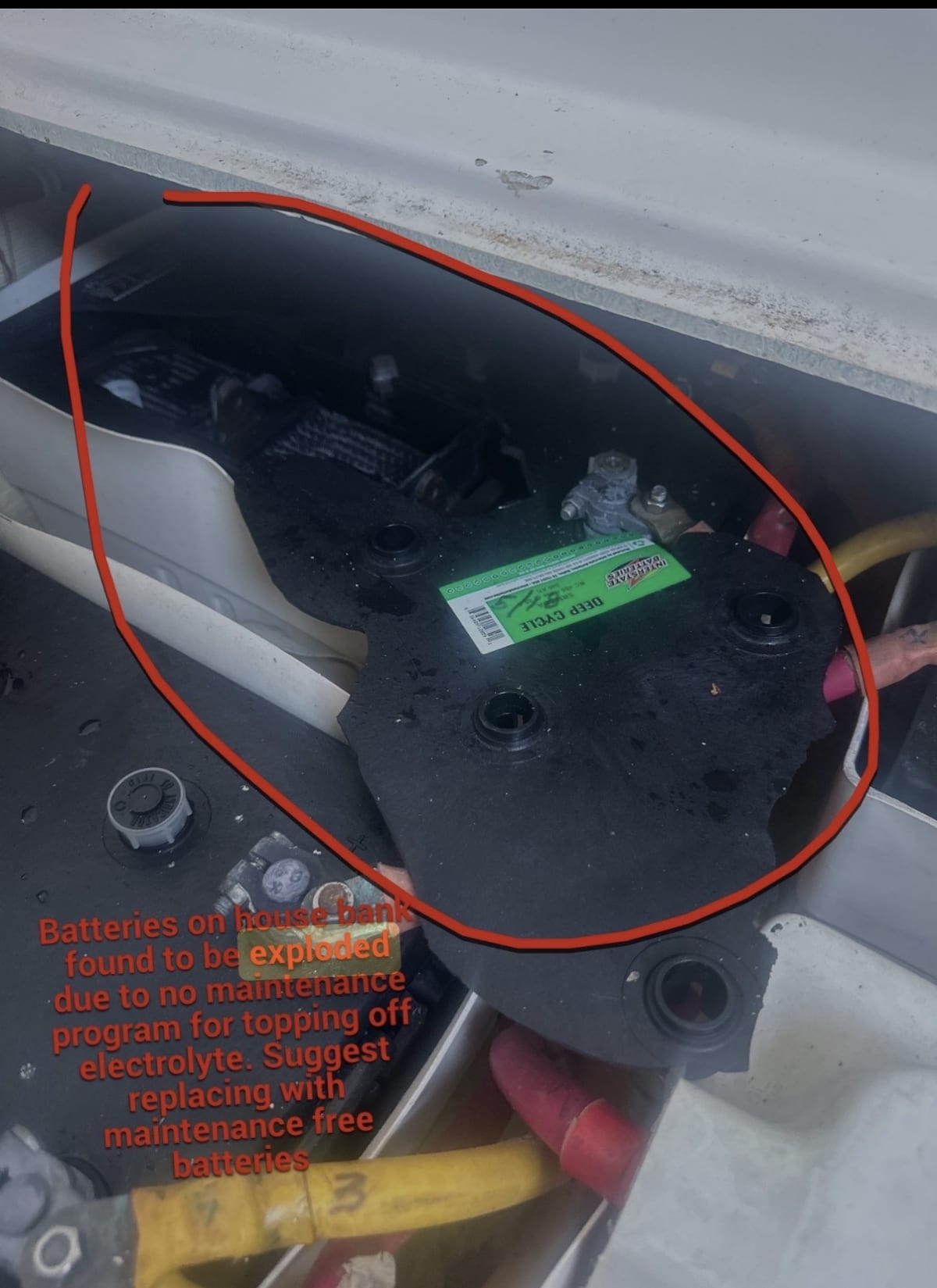
Loss of electrolyte
Plates exposed to air stop working, and the damage is permanent. On a flooded battery this comes from not topping up, from overcharging, or from heat. Top up with distilled water only, never tap water, and never acid.
Left long enough it does not just kill the battery. A flooded cell that has run dry is generating hydrogen with nowhere for it to go and no liquid to absorb the heat, and the case can rupture.
Heat and no ventilation
This is the one that catches owners out most in San Diego. A battery buried in a sealed locker beside an engine cooks. Heat accelerates every degradation mechanism there is, and roughly speaking, sustained high temperature can halve service life. Charging batteries also vent hydrogen, which is explosive and lighter than air, so it collects at the top of an enclosed space. A battery compartment needs airflow for the battery's sake and for the boat's.
Poor connections and corrosion
Not strictly a battery fault, but it produces identical symptoms and it is the first thing to check. A corroded or loose terminal adds resistance. Under a starter load, resistance turns into heat and a voltage drop, and the engine cranks slowly with a perfectly good battery underneath. Green or white powder on a terminal, a lug you can turn by hand, a cable warm after cranking. Any of those, fix that before you condemn anything.
Corrosion is also self-feeding. A loose joint flexes under load, arcs slightly, and the arcing produces more corrosion.
Group sizes: what the number does and does not mean
Group size is a Battery Council International standard that defines the physical box. Length, width, height and terminal layout. That is all it defines.
| Group | Approx. size (in) | Typical use |
|---|---|---|
| 24 | 10.3 × 6.8 × 8.9 | Smaller start battery or modest house battery |
| 27 | 12.1 × 6.8 × 8.9 | Common start and house size |
| 31 | 12.8 × 6.8 × 9.3 | The marine workhorse. Start, house, thruster |
| 4D | 20.8 × 8.7 × 9.9 | Large start or house bank on bigger boats |
| 8D | 20.8 × 11.1 × 9.9 | Big house banks and large diesels. Heavy, awkward, two-person lift |
Here is the part that matters. Group size says nothing about capacity or quality. Two group 31 batteries sitting side by side on a shelf can be built completely differently. One might be a starting battery with high CCA and modest amp hours. The other a true deep cycle with high amp hours and mediocre CCA. Same box, opposite purposes.
So when you replace a battery, matching the group size only guarantees it fits. You still have to match the specification to the job.
Terminals, and why the L terminal wins on a boat
The terminal is where most marine electrical trouble begins, because it is the only part of the battery exposed to salt air, damp and constant movement.
The tapered post, the automotive standard, uses a clamp squeezed onto a cone. Fine in a car. On a boat it is the weak option, because vibration works the clamp loose, the contact area is small, and the joint corrodes where you cannot see it.
The L terminal is a flat lead lug shaped like an L, with a bolt hole or a threaded stud. You bolt a proper crimped ring lug flat against it and tighten a nut. This is the one you want. The connection is mechanically captive, the contact area is large and flat, and a nut on a thread does not vibrate loose the way a clamp does. A threaded stud, often 3/8 inch positive and 5/16 inch negative, works on the same principle and is just as good.
A wing nut on a stud is convenient because it needs no tools, which is precisely the problem. Hand tight is not tight enough for a cranking load. If you have them, put a spanner on them. A dual terminal gives you a tapered post plus a stud so you can do either. Use the stud.

The principle behind all of it is simple. Bolted and flat beats clamped and round. Add a crimped, heat-shrunk, tinned copper ring lug sized to the cable, and a boot over the positive. Then leave it alone.
Same box, four times the price, and it is not a scam
Stand in front of a wall of group 31 batteries and the spread is startling. At the time of writing, a basic flooded group 31 sits around 150 to 250 dollars. A quality AGM in the identical footprint runs roughly 250 to 600. A lithium unit in the same box can be 600 to 1,200 or more. Prices move, so treat these as the shape of the range rather than a quote.
It gets wider as the batteries get bigger. Search a group 8D and you will find a dual purpose marine AGM from a chandlery at about 1,100 dollars sitting in the same set of results as a heavy duty 8D at about 395. Same group number, same physical box, nearly three times the price, presented side by side with nothing to explain the gap.
Owners see that and assume they are being taken for a ride. Sometimes they are. Usually they are not, and the difference is real.
- Lead purity and plate thickness. More lead and better lead means more usable surface and slower shedding. The single biggest cost driver, and you cannot see it.
- Plate count and construction. Determines whether it is genuinely built for cranking, for cycling, or is a compromise at both.
- Cycle life. A cheap deep cycle might give a few hundred cycles. A good one gives several times that. This is where the money actually is.
- Case strength and vibration resistance. Boats pound. Cheap cases crack and cheap internal supports let plates move and shed.
- Terminal quality. Tinned and substantial, or bare lead and thin.
- Honest ratings. Reputable manufacturers publish figures that survive testing. Others publish figures that flatter.
- A warranty that means something. A long warranty from a company with no local presence is a piece of paper.
The way to judge it is cost per usable cycle, not cost on the shelf. A battery at half the price that lasts a third as long, in a location that takes two hours to access, is the expensive option. On a start battery, buy on honest CCA and build quality. On a house bank, buy on cycle life.
What ABYC says about batteries on board
ABYC E-10, Storage Batteries is the standard covering selection, location, installation and wiring of batteries in DC systems at a nominal 50 volts or less. ABYC standards are voluntary, but insurers and surveyors treat them as the benchmark, and federal rules in 33 CFR 183.420 cover some of the same ground. The practical requirements owners should know:
- Restraint. The battery must be secured so it cannot move in any direction. Not wedged, not resting in a tray. Properly fastened.
- Positive terminal protection. The positive terminal must be protected from accidental contact with metal, using a boot, a non-conductive shield, a covered box or a dedicated battery compartment.
- Ventilation. The compartment must be able to disperse the hydrogen a charging battery gives off.
- No fuel above or below. Batteries must not be installed directly above or below a fuel tank, filter or fitting.
- Overcurrent protection. Circuit protection close to the battery on the positive side, sized to the cable. This lives in E-11 alongside the wider DC system rules.
- Cable and terminal quality. Correctly sized, marine grade, properly terminated, well supported.
- Lithium is its own standard. ABYC E-13 covers lithium ion, requiring a battery management system, recognised third party certification of the battery, secure restraint, and installation to the manufacturer's instructions.
Standards get revised, so if you are doing a refit or preparing for survey, check the current edition rather than relying on a summary like this one.
Looking after them
Preventative
- Label every battery with its install date in permanent marker. One minute of work that saves an entire diagnostic argument later.
- Keep them properly charged. Sulphation from chronic undercharge does more damage than heavy use. If the boat sits, a quality multi-stage charger set for the correct battery type is the best investment on this list.
- Confirm the charger matches the chemistry. Flooded, AGM, gel and lithium all want different profiles. A charger left on the wrong setting will quietly destroy a bank.
- Check flooded levels monthly in season. Distilled water only, plates just covered, do not overfill.
- Clean and protect terminals. Baking soda and water for corrosion, dry it, then a proper terminal protectant. Not grease on the mating face.
- Check tightness with a spanner, not fingers. Twice a season.
- Confirm restraints are still tight. Straps stretch and brackets loosen.
- Watch the temperature of the space they live in. If it is hot enough to be unpleasant to work in, it is hot enough to be shortening their life.
- Do not forget the generator and thruster batteries. They are the ones that get discovered dead at the worst moment.
Diagnosis, in order
- Look before you measure. Corrosion, loose lugs, a swollen or hot case, a distorted top, a smell. A bulged battery is finished and is a hazard. Deal with it.
- Isolate what you are testing. Everything off at the switches, shore power off, then disconnect the battery from the bank, negative first. A battery still wired to its neighbours cannot be tested honestly, because they will hold it up.
- Rested voltage, for context only. Off charge and disconnected for a few hours. About 12.7 is full, 12.4 is roughly three quarters, 12.0 is about half and needs charging now. Useful, but not a verdict.
- Load test, one battery at a time. The real test. On a start battery you can watch the voltage while cranking, and below roughly 9.5 volts under that load is your answer. On a house battery there is no engine to do the work, so you need a carbon pile or conductance tester. Test every battery in the bank individually and compare. The odd one out is usually the culprit.
- Voltage drop across connections. Meter across the joint itself while it is loaded. Any meaningful drop across a terminal or switch means the joint, not the battery.
- Charging output. Reconnected, engine running, expect somewhere around 13.8 to 14.4 volts at the battery on most lead acid setups. Much lower means it is not being charged. Much higher and consistently so means it is being cooked.
- Hydrometer, on flooded only. Cell by cell. One cell reading well below the others means an internal failure, and no amount of charging will fix it.
- Confirm before you spend. If a load test condemns a battery, replace it and retest before spending money on a starter, an alternator or a switch.
One more thing on house banks. If you find one bad battery in a set, think hard before replacing only that one. A new battery paired with three tired ones gets dragged down to their level fast, and you have spent money to buy a fourth tired battery. Batteries in a bank should be the same age, type and capacity.
Voltage tells you if a battery is charged. It does not tell you if a battery is any good. Those are two different questions, and only a load test answers the second one. Test under load before you go hunting for a fault somewhere else.