Docking and departing single-handed comes down to removing the timer. Rig your lines so they release and catch from on board, stop the boat before anyone leaves the helm, and let the fenders hold you while you work. If a manoeuvre needs someone to run or jump, the manoeuvre is wrong.
If you dock with your heart rate up because somebody has to leap for the dock, or you avoid taking the boat out alone because of the lines, this is for you.
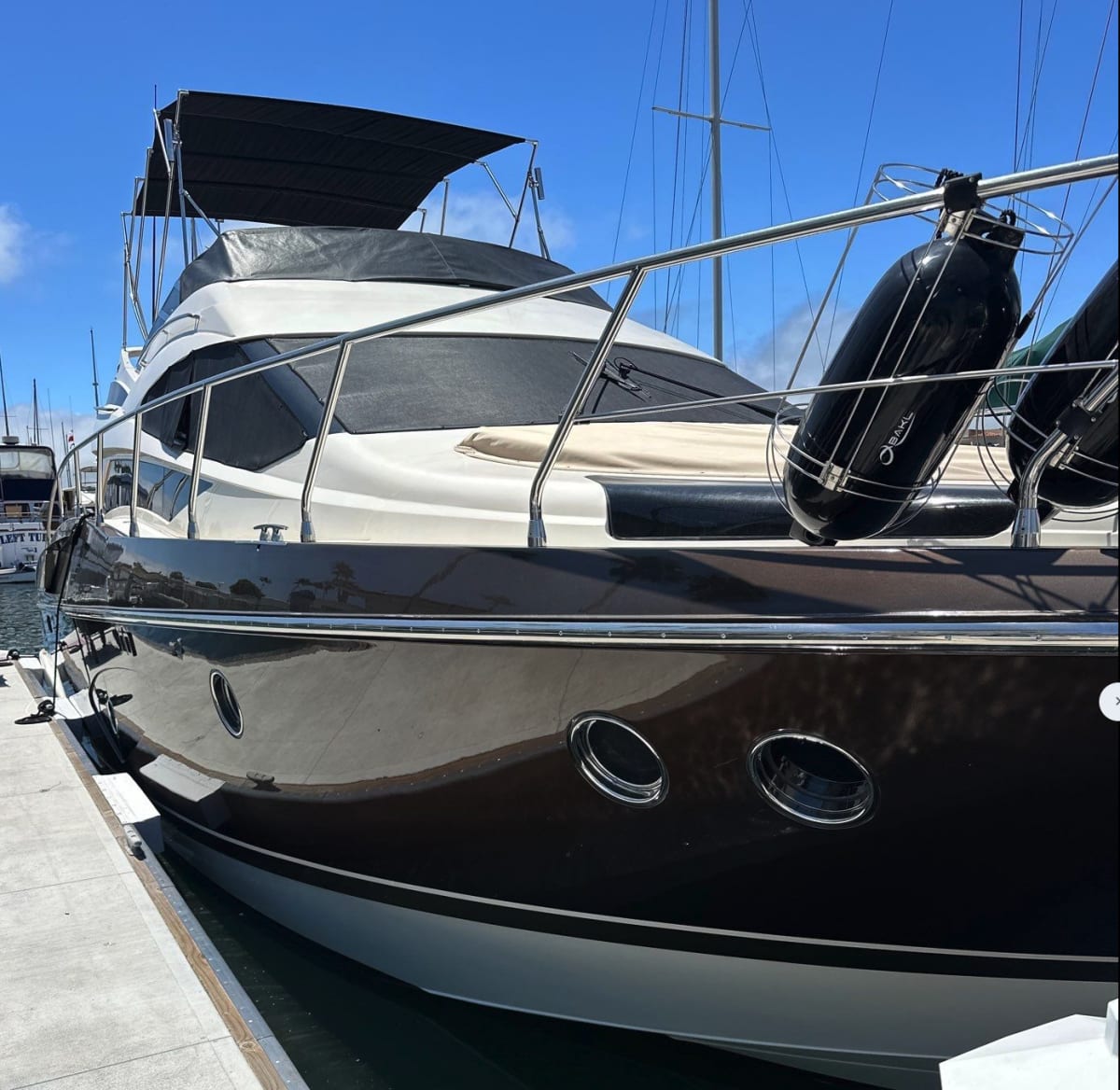
Four feet of water and a shout to jump
An owner in San Diego, I will call her Kate, came to training with a docking story most couples will recognise. Coming alongside, voices rising, and a shout to jump for the dock while the boat was still four feet off. She could not make that jump, and she was right not to try. That gap swallows people.
It was never a courage problem. It was a setup problem. The lines were rigged so departing meant someone standing ashore letting go and racing the drift back aboard, and arriving meant someone leaping to catch. The whole operation ran on a timer nobody had agreed to.
How we trained through itWe took the timer out of docking
Before a single line came off we tested what we were about to depend on. Engines in and out of gear, one at a time. Wheel centred, and actually confirmed centred. Then the bow thruster, which turned out to be switched off. Imagine discovering that mid-fairway with the wind on. Thirty seconds at the dock is where that discovery belongs.
Then we re-rigged the lines to be worked from on board. Release ends live on deck, so letting go never puts a person ashore. On arrival, the line goes out as a cast, a wide loop thrown from the boat that lands over the cleat, then tensions from the deck. Bow line off first on this boat, because with the stern still attached you can square back up on the thruster with all the time in the world.
Then the rule that changes everything: the boat is not on a timer. Once she is stopped, or resting on her fenders, nothing is happening and nothing is urgent. You can leave the helm, walk the deck at what I call geriatric grandmother pace, set a line, and come back. I exaggerate the slowness on purpose. Rushing is the actual hazard.
I teach it this way because I earned it. Years ago in Saint-Tropez I tried a running jump onto a tender in suit shoes, slipped on the take-off, and ended up half in the water hanging off a cleat while the owner stepped over my head and aboard without breaking stride. Nobody has run or jumped on my watch since.
Then Kate ran it. Departures with every line let go from the deck. Approaches finished with the boat stopped and resting while she walked forward, unhurried, and dropped the loop over the cleat. We graded the reps: an A is the manoeuvre done on momentum with almost no power, a C uses power but stays safe, and an F is a big power save. By the end of the session she was chasing As.
“I can back this boat up.”
Kate, mid-session · name changed for privacyThe boat is not on a timer. Once she is stopped, you can leave the helm, have a sandwich, and set your lines like a civilised person.
The outcomeAlongside the fuel dock, and nobody left the boat early
By the end of the session she had departed, worked the basin, and come alongside the fuel dock twice without anyone stepping off before the boat was stopped and held. No shouting, no leaping, no timer. The method is now the house rule aboard: nobody leaves the boat until there is nothing left to hurry for.
The practical win is that the boat stopped needing a committee. She takes it out on a weekday afternoon when the mood strikes, without organising anyone or apologising for the wind. That is a different kind of ownership to waiting for a free weekend and a spare pair of hands.
What you can take awayIf the manoeuvre needs a jump, the manoeuvre is wrong
Single-handed docking is about removing the timer. Rig your lines so they release and catch from on board, and there is no sprint down the side deck and no leap to a moving dock. The setup does the athletic part so you never have to.
Stop the boat before you leave the helm. Every time. A stopped boat gives you all the time in the world, and a moving one gives you none.
Let the fenders do their job while you work the lines. The boat resting gently against them is not a failure. It is the plan.
The differenceMost docking advice quietly assumes a crew
Most docking instruction assumes two fit adults, one driving and one leaping. That is why it collapses the day you are alone, or your crew is a nervous guest, or your knees have opinions. A single-handed method assumes nobody is coming to help, and then every extra pair of hands becomes a luxury instead of a requirement.
It also fixes the couples problem. When the boat is stopped and resting before anyone moves, there is nothing left to shout about. Calm at the dock is not a personality trait. It is a setup you can rig in five minutes.
We built the method around nobody helping on purpose. Train for the day someone is there and you have built a skill that depends on other people staying calm. Train for the day nobody is, and every extra hand becomes a bonus rather than a requirement. That is what independence actually means on a boat: the plan works whether or not anyone shows up, including me.
How we do itHow we set up docking without jumping
- Test everything before the lines come off. Engines in gear, wheel centred, thruster switched on. The dock is where you want the surprises.
- Rig the lines to work from on board. Release ends on deck for departure, a cast loop for arrival. Nobody stands ashore, nobody leaps for shore.
- Take the bow off first when you have a thruster. Still tied at the stern, you can square up calmly before the last line goes.
- Stop the boat before anyone moves. Stopped, or resting on fenders, means nothing is happening and there is no timer.
- Move at geriatric grandmother pace. Deliberately slow on deck. If a step needs a sprint, go back to the helm and reset.
- Grade your reps. An A uses momentum and almost no power. Chasing the A is how the feel gets built.
Nobody should ever run or jump to dock a boat. Rig the lines to work from on board, stop the boat before anyone moves, and the most stressful moment in boating becomes a slow walk on a stopped deck.