Handling a twin-engine boat in wind comes down to four foundations: drive with the engines instead of the wheel, do one manoeuvre at a time, stop the boat before you pivot, and treat the wind as the strongest hand on the boat, because it is. Get those right and twenty knots stops deciding whether you leave the slip.
If you run a twin-screw boat in the 40 to 90 foot range and the forecast still makes the decision for you, this is for you.
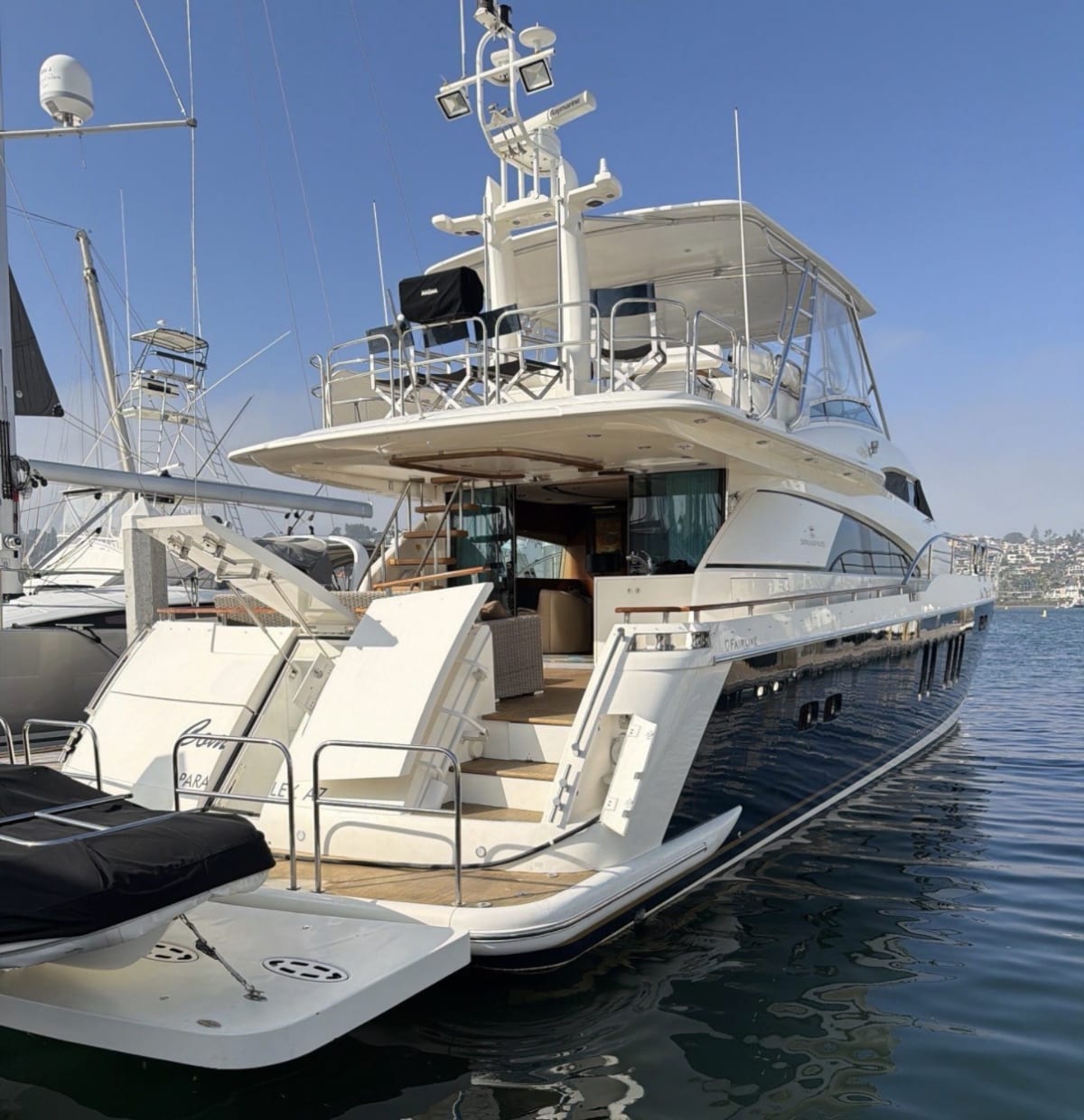
First handling day, new boat, twenty knots
A father and son wanted to learn their new twin-engine flybridge, mid-70-foot range, and the bay gave us twenty knots of northwesterly to learn her in. No stern thruster to lean on, either. It had a flat battery, which we found in the pre-departure checks, and which mattered less than you would think, because thrusters were never going to be the method.
Neither of them had run twin screws before that morning. By the afternoon both of them had held her on station in the gusts, pivoted her on the spot in a tight basin, and understood exactly why the wheel had barely been touched all day.
How we trained through itThe wind is the boss, so we made it do the work
We learned her characteristics first, in open water, before asking anything hard of her. How fast she builds momentum, how long she takes to shed it, measured properly: pick a perpendicular reference on shore, come off the power, and watch when it stops moving against the land. Not a feeling. A fact about this boat.
Then the first rule of close quarters: the rudder does not exist. At manoeuvring speed there is not enough water over it to matter, so it gets centred and retired, and the boat is driven like a tracked machine. Both engines ahead to go, both astern to stop, split them, one ahead and one astern, to pivot on the spot. When the wind starts winning, momentum is how you answer: small kicks of both engines together, never speed for its own sake.
Second rule: one axis at a time. Down the fairway, stop. Pivot, stop. Sideways in, stop. Every manoeuvre separated, so there is always a still moment to think in. And the anchor rule that rescues every drifting plan: whenever you feel lost or the picture gets busy, stop the boat first. A stopped boat gives you back the one thing wind takes off you, which is time.
Third: give the wind a job. Never follow it into a slip. Set the approach so it holds you off or lays you gently on. Aim off for leeway, point at the windward marker and let the drift park you in the middle. And on arrival, resting on your fenders is not a failure, it is the plan. The danger was never touching the dock. It is sliding along it.
And everything happens slowly. I move around a boat like a sore ninety-year-old on purpose, and I earned that habit the hard way. Years ago in Saint-Tropez, trying to look slick for a superyacht owner, I took a running jump at a tender in suit shoes, slipped on the take-off, and ended up half in the water hanging off a cleat while the owner stepped aboard past me without breaking stride. I have not run or jumped on a boat since, and neither will you. If the manoeuvre needs a sprint, the manoeuvre was wrong. Reset and go again.
The wind is the boss. Your job is to keep telling the boat otherwise, and momentum is how you say it.
The outcomeFrom passengers to pivoting on a dime
By the end of the session the son, who had never touched twin screws that morning, was splitting her around a tight basin and holding station in the gusts while the water traffic went about its business. The father had the feel back and the method named. We finished by bringing her into an unfamiliar marina, wind on, with the approach planned out loud: commit fully, use the momentum, let the fenders take her. The homework is repetitions, ten departures and ten arrivals each, stacked close together, because that is what turns a method into a reflex.
“I've definitely learned a lot in the past twenty minutes.”
Ben, Mike's son, first day on twin screws · name changed for privacyThe knock-on is where it counts. Guest docks and fuel docks stopped being a reason to change the plan, so the boat goes places it used to avoid, and arriving somewhere new is now the good part of the day rather than the bit to survive.
What you can take awayDrive with the engines and give the wind a job
In close quarters on a twin-engine boat, the wheel is mostly a distraction. Split the engines and steer with thrust. It is slower, more precise, and it works at speeds where the rudders do nothing.
One manoeuvre at a time, and stop the boat before you pivot. Most close-quarters trouble comes from stacking movements on top of each other with way still on.
Treat the wind as the strongest hand on the boat, because it is. Plan the approach so it helps you on or holds you off, and twenty knots stops deciding whether you leave the slip.
The differenceFoundations transfer. Button sequences do not.
A lot of handling instruction is a recipe: push this, then this, then bow thruster to finish. It works until the day the thruster times out, the wind is ten knots stronger, or you are standing on a different boat. This session ran on a boat with a dead stern thruster in twenty knots, and it did not matter, because the method never needed it.
Characteristics-based training teaches you to read the boat you are standing on: her momentum, her pivot point, her response to wind. Those foundations are the same from a 40-footer to a cruise ship. What changes is how far ahead you have to think. Learn the foundations on your boat and every future boat gets easier. Learn a button sequence and you have learned one boat, in one wind, on one day.
We ran the session on a boat with a dead stern thruster on purpose. Teach the button sequence and the owner is fine until the day the gear is not, which is exactly the day it matters. Teach the foundations and the boat is drivable in any condition, on any similar boat, with or without help. Skills that only work when everything is working are not skills yet.
How we do itHow we teach twin-engine handling in wind
- Learn the characteristics before the manoeuvres. Momentum, stopping distance, pivot point, wind response, measured in open water where mistakes are free.
- Retire the wheel. Centre the rudder and drive on the engines. At close-quarters speed the wheel is a distraction dressed as a control.
- One axis at a time. Forward, stop. Pivot, stop. Sideways, stop. Separated manoeuvres keep decisions clean when the wind is trying to rush you.
- Stop the boat first. Lost, distracted, or crowded, the reset is always the same. A stopped boat gives you time, and time beats talent.
- Make the wind a tool. Plan every approach and departure around where it is pushing you, aim off for leeway, and let it hold you on or off the dock instead of fighting it.
- Slow everything down. No running, no jumping, no racing the boat. If a manoeuvre needs a sprint, reset and start it again properly.
In close quarters the wheel is a distraction and the wind is the boss. Split the engines, do one thing at a time, stop before you pivot, and give the wind a job. That is the whole method.