New boat familiarization is a structured first day aboard a boat you have just bought: her systems, her handling characteristics, and her quirks, learned with a professional beside you instead of by expensive surprise. Done properly, one day takes you from holding the keys to actually running the boat. It also finds the problems before they find you.
If you have just bought a boat in the 40 to 90 foot range in San Diego, or stepped up to one, and the handover amounted to a folder of manuals and a wave from the broker, this is for you.
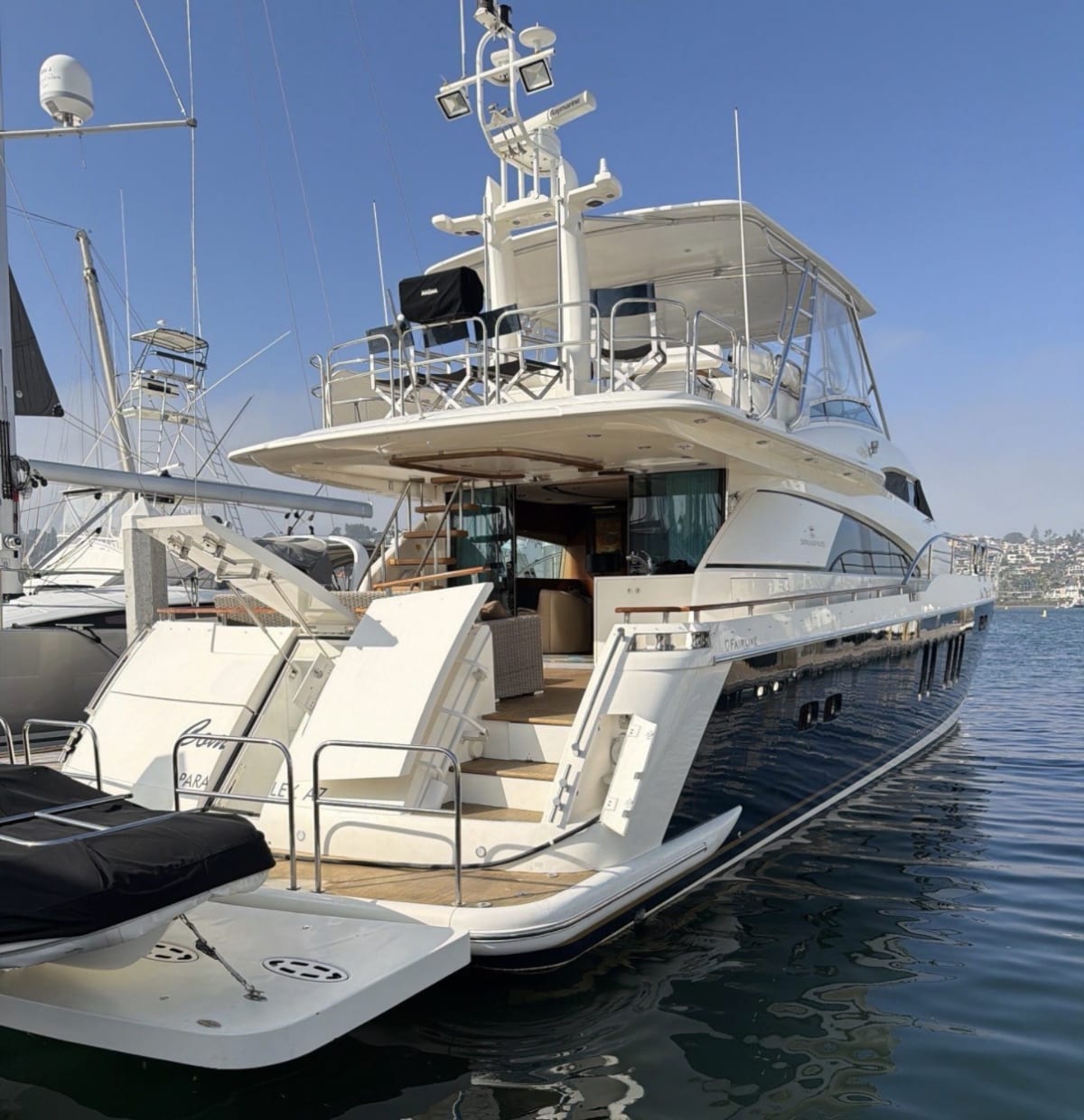
Two capable people, one boat nobody had handed over
A father and son took delivery of a twin-engine flybridge motoryacht in the mid-70-foot range. Twenty years old, original electronics, plenty of life in her. The father had spent a lifetime around boats, big ones included, but had been out of the game for years. The son was capable and keen, and had never run twin screws in his life. Between them they had everything they needed except time on this boat.
She had already thrown her first surprise before we cast off: the tender crane would not go down. That is what a new-to-you boat is. Not a mystery, just a machine full of habits nobody has introduced you to yet. The question was never whether they could learn her. It was whether they would learn her by plan or by incident.
How we trained through itOne day, run as a proper handover
We started with a conversation on the aft deck, not with engines. What did they want out of it? To feel how she moved. To try the thrusters somewhere they could not hit anything. To learn a proper pre-departure process. And to set both of them up to operate solo, so a good day on the water never depends on who else is free.
Then we ran my full pre-departure checklist, not as a formality but as the lesson itself. Weather done on their own phones, so the muscle memory lands in their hands: reading wind, swell, and period for the whole passage, not just the morning. A passage plan built waypoint by waypoint, with the reasoning said out loud. Then down into the engine room: oils, coolant, fuel filters, seacocks, strainers, bilges. Every check framed the same way. This is you building data on what normal looks like, so the day something is not normal, you catch it.
The method underneath it is simple. Learn one, do one, teach one. I narrate a task, they do the task, then they explain it back. By the time we left the dock, the son was running the checklist and the father was auditing him.
Preparing the anchor to drop is on that checklist, and it is exactly how we found the windlass seized before we needed it in anger. That is the day working as designed. By the end we had found five real issues: the seized windlass, an autopilot fault, a raw-water weep, a flat thruster battery, and fuel crossovers left open. Five surprises converted into a calm work list instead of five future incidents.
Then we took her out and learned her characteristics in open water before asking anything of her in close quarters. How fast she builds momentum, how long she takes to shed it, where she pivots. Both of them drove. And we finished by bringing her into an unfamiliar marina in twenty knots, planned, briefed, and unhurried.
The boat does not get longer or wider when she leaves the dock. What changes is how far ahead you are thinking.
The outcomeFrom holding the keys to running the boat
By the end of one day they had departed, handled, and docked a boat they had barely run that morning, in real wind. They left with homework, a weather read texted to me before their next trip so I can check their eye, and with the next blocks already scoped: docking repetitions, an anchoring method, a night passage. The defect list went to quotes, not to worry. The father said he learned a lot more than he thought he was going to. That is what a handover is supposed to feel like.
“I learned a lot more than I thought I was going to be doing today.”
Mike, the owner, at the end of the day · name changed for privacyThey used the boat the following weekend, which sounds small and is not. Plenty of new owners let a boat sit for months while the nerve builds, losing a season to hesitation. One structured day meant their first trip was something they looked forward to instead of something they kept deferring.
What you can take awayThe paperwork makes it yours, familiarization makes it safe
A new boat has systems, handling characteristics, and quirks you do not know yet, and the expensive way to learn them is by surprise. One structured first day aboard, walking every system and feeling how she moves, replaces months of guesswork.
Learn what normal looks like before you need to spot abnormal. Gauge readings, engine sounds, how she sits and idles. That baseline is what lets you catch a problem while it is still cheap.
Handle her gently in open water before you handle her in a fairway. Every boat pivots, drifts, and carries way differently, and the first tight-quarters surprise should happen where there is nothing to hit.
The differenceA walkthrough is not a handover
Most owners get one of two things with a new boat. A broker walkthrough, which is an hour of light switches and where the fenders live. Or a sea trial, which proves the boat works, not that you work on the boat. Neither one hands the boat over. They hand you the keys and the risk at the same time.
A familiarization day is curated to the people standing on the deck. On this one, that meant a refresher pace for a father with decades behind him and foundations for a son new to twin screws, run in parallel, with both trained to a solo standard. The same day for a nervous first-time owner looks completely different. That is the point. The boat sets half the curriculum. You set the other half.
The day is built around the people on the deck rather than a curriculum, because the goal is not to demonstrate the boat, it is to hand it over properly. That means the owner drives, the owner docks, and the owner makes the calls while I stand beside them and say as little as I can get away with. You should finish the day owning the boat in the way that actually matters, which is knowing you can run it tomorrow without me.
How we do itHow we run a new boat familiarization
- Start with expectations, not engines. We agree what capable looks like for you before we touch a switch, and the day is built backwards from that.
- Run the pre-departure checklist as the lesson. Weather, passage plan, fluids, seacocks, bilges. You do the checks, in your muscle memory, building your baseline of what normal looks like on this boat.
- Hunt the quirks on purpose. Every boat has habits. We go find them at the dock, where they are cheap, instead of underway, where they are not.
- Learn her characteristics in open water first. Momentum, stopping distance, pivot point, wind response. Close quarters comes after the boat has introduced herself.
- Learn one, do one, teach one. I narrate it, you do it, you explain it back. A skill you can teach is a skill you own.
- Leave with homework and the next block planned. Familiarity fades fast without repetition, so the reps are scheduled before the glow wears off.
A boat is not yours when the paperwork clears. She is yours when you know what normal looks like, how she moves, and what she is going to do before she does it. One structured day gets you most of the way there.